


Bound? Confined? Hardly.
Posted by jeneration on Feb 13, 2016 in Blog | 0 comments
It’s not uncommon for the media – print, online and broadcast – to refer to someone who uses a wheelchair as “wheelchair-bound” or “confined to a wheelchair.” I hate to burst their pity or sympathy-evoking bubbles, but I’m not “bound” or “confined” to my wheelchair. No one is.
Webster’s Dictionary offers the following definition of the word, “bound”:
“something that limits or restrains.”
I think many people who use wheelchairs would not say they are limited or restrained by their wheelchair. If anything it’s the opposite. Their wheelchair makes it possible for them to move around and do things, and without their wheelchair they would actually be limited or restrained to one place. My wheelchair certainly has not limited me. It’s made it possible for me to go to school, college and work, play sports and be with friends, and visit 11 countries (so far).
And when we think of the word “restrained” we typically think of a physical restraint, such as something physically holding us down and keeping us in place, and something being used against our will or something seen as a negative thing. Sure, we have seatbelts and sometimes other straps or accessories on our wheelchairs, but they are for safety and comfort, not for holding us down in our wheelchairs. Generally speaking, they are not things we are forced to wear against our will and they are not a negative or mean thing. We aren’t in our wheelchairs against our will. They certainly aren’t restraining like a straight jacket.
When it comes to the word “confine” (the actual word confined refers to childbirth), Webster’s gives the following definitions:
“to keep (someone or something) within limits : to prevent (someone or something) from going beyond a particular limit, area, etc.”
“to keep (a person or animal) in a place (such as a prison) — usually used as (be) confined.”
“to force or cause (someone) to stay in something (such as a bed or wheelchair) — usually used as (be) confined.”
Again, we are not limited by or with our wheelchair. We can move and do things. Normal things, in fact. And many people can reach things beyond the space of their wheelchair (or have the ability to at least stand-up to reach something).
That last definition is what’s problematic. While our disability causes us to require the use of a wheelchair, again we aren’t being forced. We don’t have to be in our wheelchair if we don’t want to. We could be in bed, on a couch, in another regular chair, in a lawn chase, laying on a beach or swimming in a pool. We could sit or lay anywhere. We can get out of our wheelchair whenever we want (obviously some of us need assistance).
Using the words “bound” or “confined” ultimately makes it sound like we are stuck in our wheelchair and cannot get out, like we are strapped in against our will as some form of torture or punishment. It makes it sound like our wheelchair is permanently attached to us like a fifth extremity. If you know someone who uses a wheelchair you know none of this is true… and if you thought otherwise you obviously don’t know that person very well at all.
I often picture the image from Silence of the Lambs because that it what I picture as being “bound” or “confined.”
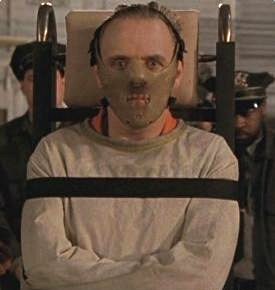
More appropriate phrases to use are “(name) who uses a wheelchair…,” “(name) uses a wheelchair due to the affects of…,” “(name) utilizes a wheelchair for daily mobility….” I think you get the idea.
In this politically-correct society I’m surprised the media still uses these old school terms. Editors, journalists, reporters, it’s time to get with the times.
I could also go on and on about their use of the word “suffers” when referencing a chronic and disabling condition, but that’s for another day… 🙂
Recent Comments